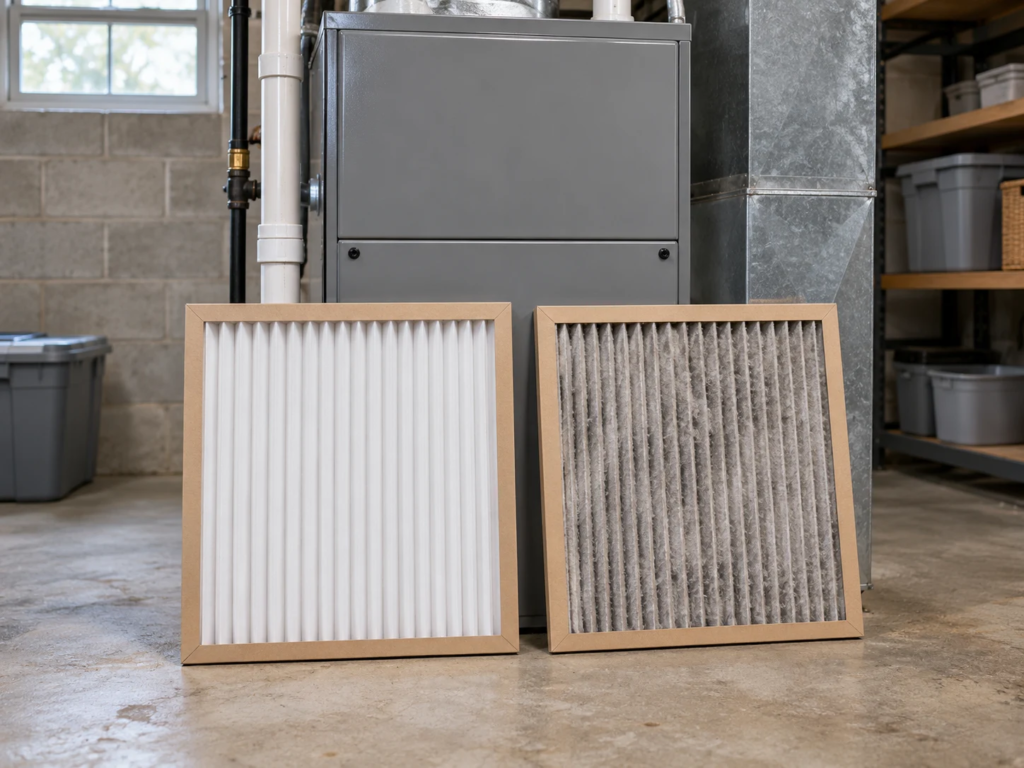
Choose a furnace filter rated MERV 13 if your system can accommodate it. EPA recommends that level, or the highest rating the fan and filter slot can handle. Match the dimensions and thickness specified for your furnace before buying. MPR and FPR numbers on the box use different scales.
What a MERV rating measures
Minimum Efficiency Reporting Value, the full name behind MERV, rates how well a filter catches particles from 0.3 to 10 microns across. The test method comes from ASHRAE, the engineering society for heating and air conditioning. Each step up the scale sets a higher minimum catch in three size bands:
| Rating | 0.3 to 1 micron | 1 to 3 microns | 3 to 10 microns |
|---|---|---|---|
| MERV 8 | No minimum | 20% or more | 70% or more |
| MERV 11 | 20% or more | 65% or more | 85% or more |
| MERV 13 | 50% or more | 85% or more | 90% or more |
A MERV 8 has no required catch in the smallest band at all. MERV 11 is the first of the three that does, and a MERV 13 has to catch at least half. For PM2.5, the fine particles EPA counts as the greatest health concern, the advice is the highest rating your system can take.
The higher small-particle capture makes MERV 13 worth considering when the system can use it. A filter that restricts airflow beyond the system’s limits is not a useful upgrade.
MPR and FPR aren’t MERV
Two other scales show up on furnace filter boxes, MPR and FPR. EPA calls both proprietary, where MERV comes from a national consensus standard. MPR is 3M’s scale for its Filtrete filters, and the company prints a MERV on the same filters, listing its 700 MPR filter as a MERV 8.
A box that leads with 1000 or 1900 is giving you a brand’s own scale. Look for the word MERV in the smaller print, and compare filters on that. We’d pass on a filter that gives no MERV at all, since there’s nothing to compare it with.
Will your furnace take a MERV 13?
Most furnaces and HVAC systems can use a MERV 13 without equipment problems, provided the filter is replaced often. A dirty filter can raise energy costs and damage the equipment, leading to early failure, ENERGY STAR warns.
Furnaces seldom come labeled with a filter recommendation, so you may not find an answer on the cabinet. An HVAC technician can tell you the most efficient filter your system can use, and can change the system to take a better one. Before going past MERV 13, we’d ask one.
Filters come 1 to 5 inches thick, in sizes that match common furnace frames. Buy one that fits snugly, so air can’t slip around the edges, and never bend or crush a filter to make it fit. Measure the old filter before you shop.
The filter cleans only while the blower runs
EPA’s guide points out that a furnace filter cleans the air only while the system is running. In heating season that’s usually less than a quarter of the time. Running the fan longer filters more air, but it also raises the electric bill.
For one room you want cleaner all night, the same guide covers portable air cleaners sized to the room.
Check it every month
Inspect the filter monthly, as ENERGY STAR advises. Replace it according to the filter and HVAC manufacturers’ instructions, and sooner if it becomes heavily soiled. A universal 60-to-90-day interval does not fit every filter or home.
Write the date on the new filter’s frame when you slide it in, and pull it out for a look in a month.