If condensation appears on the inside of your windows, reduce the moisture you’re adding to the room and check the humidity. Cold glass can fall below the air’s dew point, the temperature at which moisture condenses. A humidifier setting that worked during mild weather may be too high during a cold spell.
Use outdoor temperature as a guide
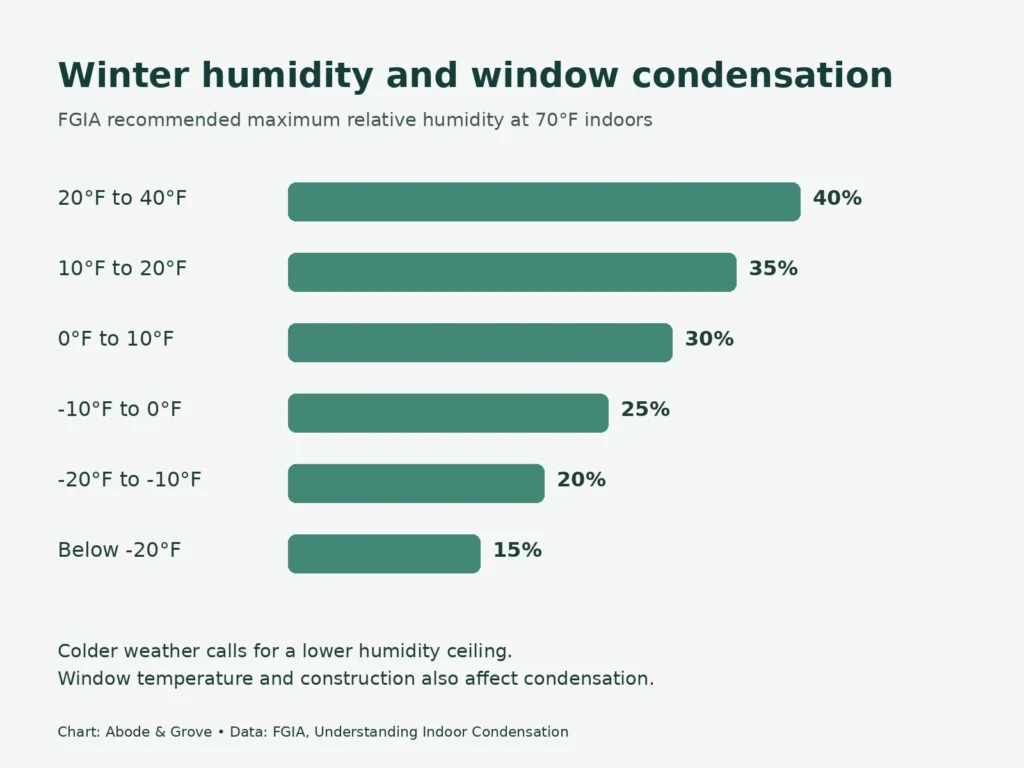
The Fenestration and Glazing Industry Alliance gives these recommended maximum relative-humidity levels for a home kept at 70°F. They are guidance for reducing condensation, not a guarantee that every window will stay dry.
| Outdoor temperature | Recommended maximum indoor humidity |
|---|---|
| 20°F to 40°F | 40% |
| 10°F to 20°F | 35% |
| 0°F to 10°F | 30% |
| -10°F to 0°F | 25% |
| -20°F to -10°F | 20% |
| Below -20°F | 15% |
The window’s surface temperature matters too. Montana State University Extension explains that single-pane windows are prone to condensation and that storm windows can help by keeping the interior surface warmer.
A general humidity limit isn’t a winter setting
EPA says not to humidify a home above 50% relative humidity. That upper limit does not mean 50% is appropriate beside cold windows. Use a hygrometer to measure the room, then reduce the humidifier setting, run it less or move it if moisture collects on nearby surfaces.
Check moisture sources before blaming the windows
Montana State University’s guidance says never to vent a clothes dryer indoors. Check that its exhaust goes outside. Our dryer-vent cleaning guide covers that maintenance task. Use exhaust fans for cooking and bathing, cover boiling pots and avoid drying laundry indoors during cold weather. FGIA also recommends opening curtains and blinds during the day to help air reach the glass.
Keep the humidifier clean
For portable units, EPA recommends emptying the tank, wiping it dry and refilling it daily, with cleaning every third day. Unplug it before cleaning and follow its manufacturer’s instructions. EPA recommends low-mineral water, such as distilled water, for ultrasonic and impeller models, which can disperse tank minerals and microorganisms into the air.
Keep the area around the unit dry. If you use a steam humidifier or vaporizer, keep it away from children because hot water and steam can cause burns.
Persistent moisture deserves attention beyond the glass. Montana State University’s guidance warns that condensation in cold walls, attics and crawl spaces can damage framing and insulation. Reducing a humidifier’s output won’t repair a ventilation or building-envelope problem.