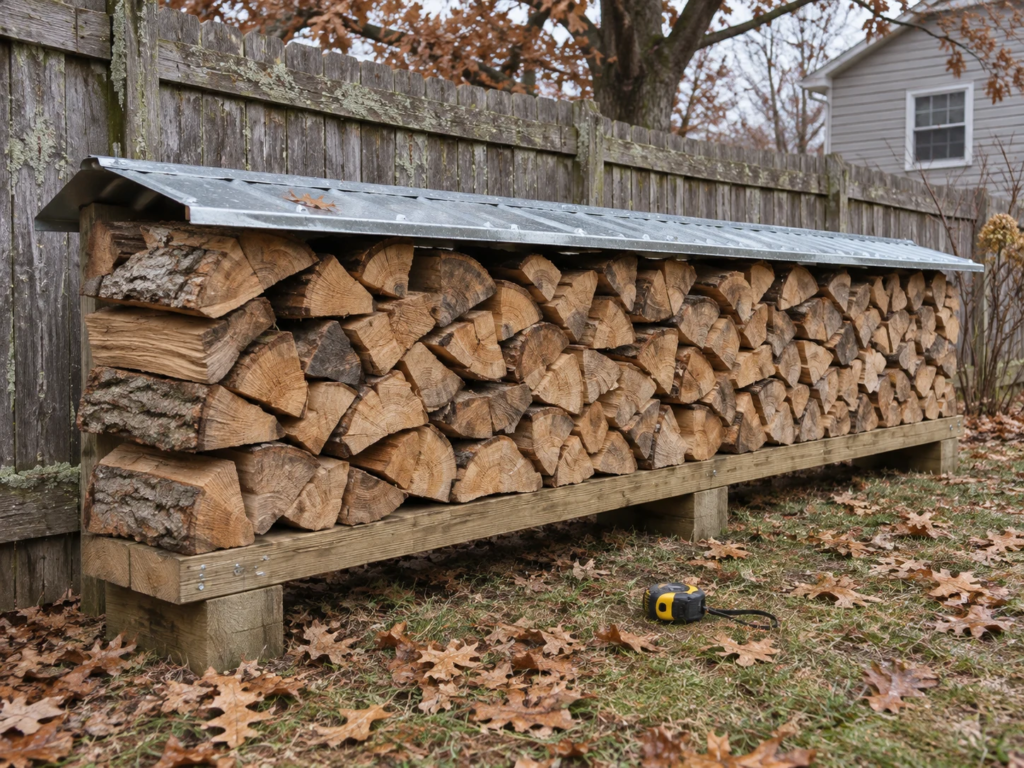
Before paying for a bulk firewood delivery, ask for its volume in cords or a fraction of a cord. NCWM’s consumer guide defines a cord as 128 cubic feet of closely stacked wood, including the spaces in the stack. Measure it before burning any of the delivery.
How big a cord is
NCWM’s consumer guide draws the cord two ways. One stack is 8 feet long, 4 feet high and as deep as it is tall. The other runs 16 feet long at the same height, but only 2 feet deep.
To check a pile, stack it neatly in rows, with the pieces touching and parallel and as few gaps as you can manage. Then multiply the width, height and length. A total of 128 cubic feet is a cord.
Say your logs are 16 inches long and you stack them in one row. At 4 feet high, a full cord makes a row 24 feet long, by our arithmetic.
The same sum shows why a face cord needs a stated log length. Picture a row 4 feet high and 8 feet long. With 16-inch logs it holds a third of a cord, and with 12-inch logs a quarter, though both rows look the same from the front.
We’d skip a seller who won’t write a fraction of a cord on the receipt. Without it, a short delivery comes down to your word against theirs.
Checking the delivery
NCWM’s guide asks for a receipt that shows the seller’s name and address, the price, the amount and the kind of wood. If you can, get the seller’s phone number and write down the delivery truck’s license plate.
Ask the seller to stack the wood, which may cost extra, or stack it yourself. Then measure it before you use any. If the volume comes up short, contact the seller before you burn a single piece.
If the seller can’t or won’t fix it, contact your state weights and measures office, again before burning any wood. A photo of the stacked pile helps document the shortage.
On a first order from a new seller, we think paying for the stacking is money well spent. Measuring the seller’s stack gives you both the same delivery record.
Dry wood burns cleaner
EPA’s archived Burn Wise guidance recommends dry, split, well-seasoned wood. The program stopped updating its content in 2025. Its practical signs of seasoned wood include lower weight and a hollow sound, but a moisture meter gives a more useful check.
Wood burns best below 20 percent moisture, and EPA suggests checking it with a wood moisture meter before you burn it. Season wood for at least six months. Store it outdoors and off the ground, with only the top covered, because covered sides trap moisture.
If a load reads wet, keep it stacked to dry until it meets the moisture target. Six months is a starting period, not a guarantee that every species and log size will be ready by then.
Buy it near where you burn it
Tree-killing insects and diseases can hide inside firewood or on its surface. The pests don’t travel far on their own, but a load of firewood can carry them hundreds of miles. That was the U.S. Department of Agriculture’s warning on October 1, at the start of National Firewood Month. Among them, USDA names spongy moth, Asian longhorned beetle and emerald ash borer.
Several states have quarantines that limit moving untreated firewood within or across state lines. If you heat with wood, USDA’s advice is to buy from a reputable local dealer who follows those rules. When wood has to travel, choose certified heat-treated firewood with a state or federal mark on the package.
Wood bought for a cabin or a campsite stays there. USDA asks you to burn the leftovers where you bought them instead of bringing them home.