The small amount of soil you mail has to represent a whole lawn or garden bed. Mix slices from several spots in one area, keeping lawns and garden beds in separate samples. Your receiving lab sets the depth, number of slices and amount to send, which may be about a cup or a pint. Allow roughly half an hour per area by our estimate, plus drying time.
The steps here come from the sampling instructions of five state university soil labs: Penn State, Michigan State, Minnesota, Delaware and Vermont. All five use the same method, but their depths and slice counts vary, so follow your own lab's form where they differ.
Fall suits the job, as long as the ground isn't frozen. Lime reacts slowly, and Delaware's lab wants it mixed into the soil several months before planting, so a test this fall leaves time to act on it before spring.
Before you start
- A sample bag and form from your state's soil lab
- A clean trowel, spade or soil probe
- A clean plastic bucket
- Newspaper
- A rough sketch of your yard
County Extension offices often sell the lab's kit. Use a bucket that has never held fertilizer or lime. Delaware's lab warns that a little fertilizer or limestone left on a tool, a bucket or your hands can seriously contaminate a sample, so rinse the tools even if they look clean.
Divide the yard into sampling areas
Each bag stands for one area that you look after as a unit. Delaware's lab splits a typical yard into three samples: the vegetable garden, the lawn and the shrub planting. Front and back lawns get a bag each if they've been fertilized or limed differently.
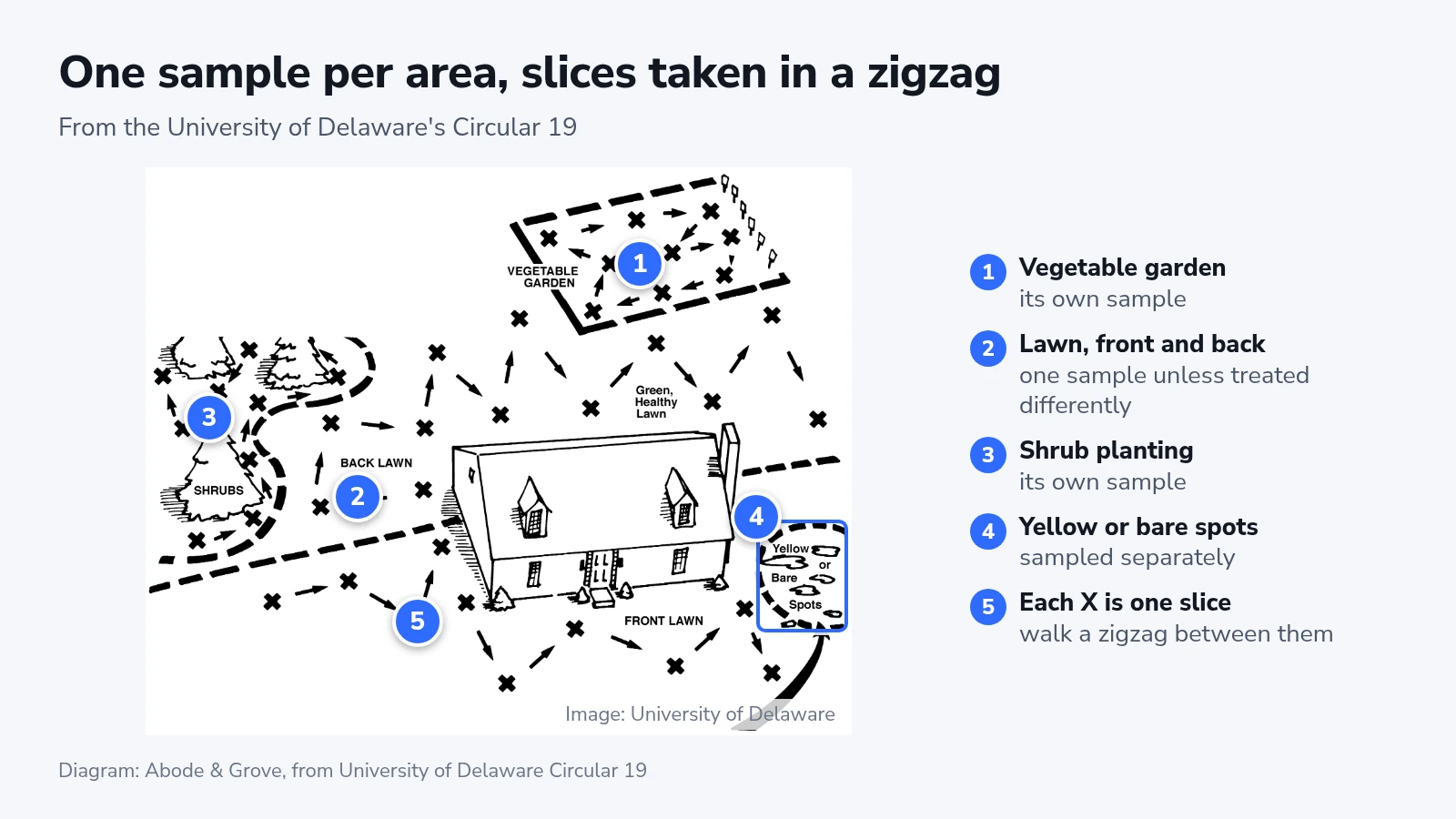
Skip any spot where fertilizer or lime was spilled, as Vermont's lab asks. Minnesota's lab adds borders, low spots and soil near trees or buildings, and it says never to mix lawn soil and garden soil in one sample.
A patch of yellow or bare grass deserves a bag of its own. Vermont's lab suggests one sample for the good area and one for the poor one, so the two reports show whether fertility is the cause. If you can pay for only two kits, give one to the vegetable garden before splitting a lawn, because Delaware's lab wants a garden retested more often.
Find your lab's depth and slice count
For an established lawn, Penn State's lab wants slices 2 to 3 inches deep. Vermont's lab wants 4 to 6. The other three fall between those two for a lawn, and their garden depths and slice counts vary as well:
| Lab | Established lawn | Vegetable garden | Spots per sample | Soil to send |
|---|---|---|---|---|
| Penn State | 2 to 3 inches | 6 inches, or plow depth | 12 or more (13 for a garden) | 1 cup |
| Michigan State | 3 inches | 7 inches | 10 | About 1 cup |
| Minnesota | 3 inches | 6 inches | 5 | About a pint |
| Delaware | 4 to 5 inches | 6 to 8 inches | 10 or more | Up to the line on the bag |
| Vermont | 4 to 6 inches | 6 to 10 inches | 10 or more | About 1 cup |
Use the depth on the form that goes with your sample. The lab interprets the result for the sampling depth it requested, so another state’s instructions are not interchangeable.
The more cores you mix, the better the sample stands for the whole area, Vermont's lab says, so take more slices than your lab's minimum. Each extra slice takes about a minute. Vermont's minimum of 10 covers an area up to 10,000 square feet. A bigger area needs 15 to 20.
A few plantings take a different depth:
- A new lawn: Minnesota's lab samples 6 inches for new grass and 3 for an established one. Penn State's lab wants a separate kit for each.
- Trees and shrubs: Minnesota samples to 12 inches. Penn State samples fruit trees just inside the drip line, to 8 inches. It mixes at least 15 to 20 cores. Delaware takes 5 or 6 spots around the base of the plant.
- A lead test: Minnesota samples only the top 3/4 inch for it, so it's a separate sample from the fertility one.
Collect the slices
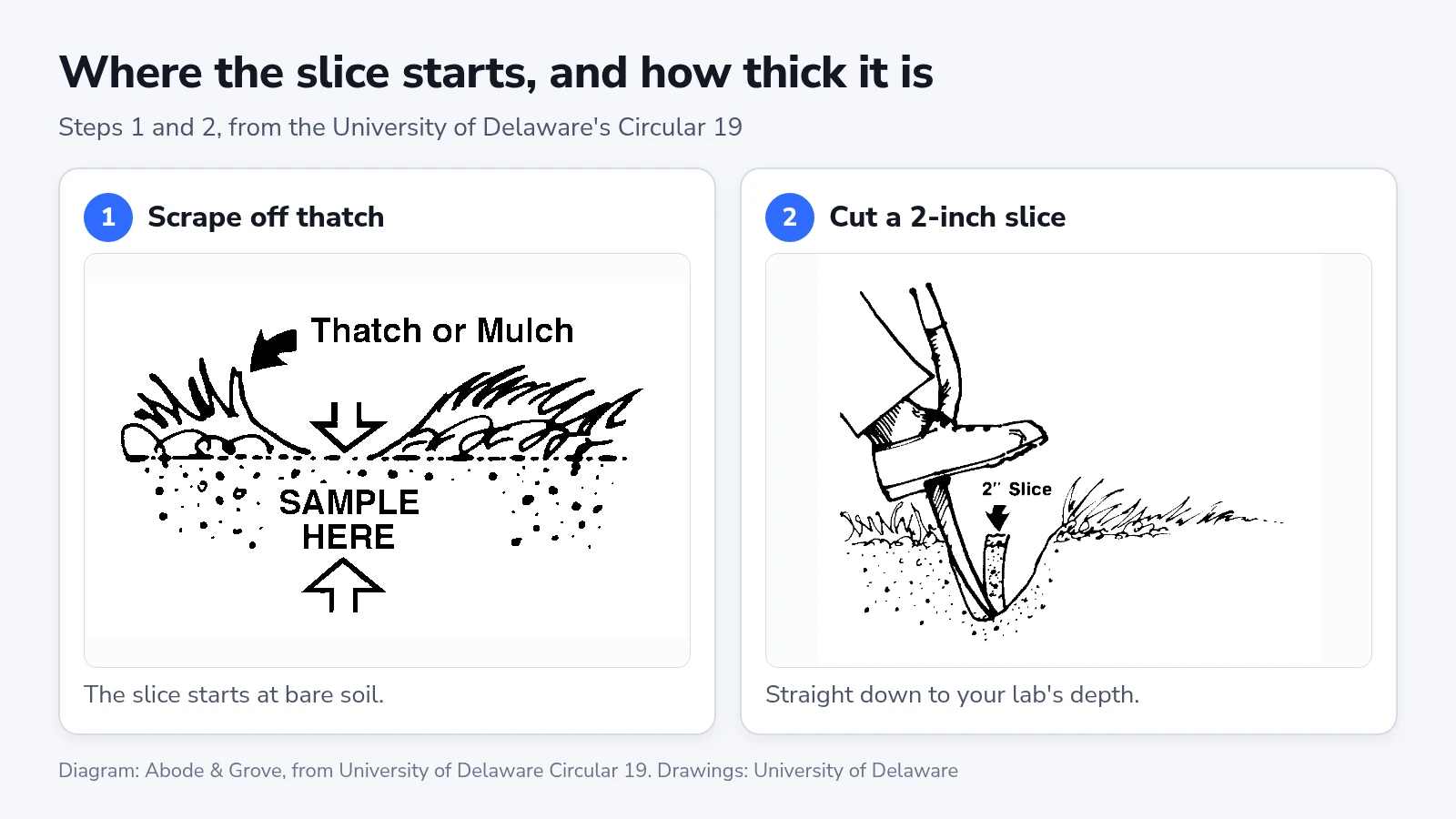
- Scrape the grass, thatch, mulch or leaves off the first spot, so the slice starts at bare soil.
- Cut each slice from the surface to your lab’s required depth, using that lab’s sampling method. Delaware describes a 2-inch slice. Vermont instead describes a thin half-inch slice trimmed to a 1-inch strip.
- Drop the slice into the bucket and push the soil you moved back into the hole.
- Walk a zigzag across the area to the next spot, and repeat until you have your lab's number of slices.
- Crumble the soil in the bucket, pick out roots, grass and thatch, and mix it well.
- Spread the mix on newspaper in a warm room and let it air-dry overnight, with no heat.
Expect a few cups of soil in the bucket. Michigan State's lab puts each slice at about half a cup, so ten slices make about five cups, and only about one of them goes in the bag.
Vermont's lab calls a soil probe or an auger the best tool for sampling. For one lawn and one garden every few years, a trowel and a spade are enough, so we wouldn't buy one. Very stony or gravelly ground is the exception: Vermont says it needs an auger.
Don't force-dry the soil on a radiator, in an oven or microwave, or with a hair dryer, Michigan State's lab says. Leave it overnight and bag it in the morning.
Bag, label and mail it
- Fill the bag or container with the amount your lab requests. Minnesota asks for about a pint, while other labs here request about a cup or a marked fill line. Do not overfill it.
- Give the sample a short name, write it on the bag and mark the area on your sketch.
- Fill out the information sheet that came with the bag, one sheet per sample.
- Mail the sample, or drop it at your county Extension office if your lab takes samples there.
Minnesota's lab asks for a name of 4 letters or numbers that you choose. Penn State wants the sample in a padded mailer or a small box, weighed as a parcel and not sent as a letter. Michigan State's mailer comes with a postage-paid envelope, and the lab asks you not to pour loose soil into it.
If the sample goes wrong
| What went wrong | What to do |
|---|---|
| The ground is frozen | Wait for a thaw. Minnesota's lab takes samples whenever soil conditions permit. |
| Lawn and garden soil are in one bucket | Empty it and start that area again. One report can't describe two areas you'll feed differently. |
| The soil is too wet to crumble | Spread it thinner on the newspaper and leave it another night. |
| Lime, fertilizer or manure went down this fall | Vermont's lab wants samples taken before any of them go on. If you've already spread some, ask your lab how long to wait. |
| You can't tell which bag came from which area | Sample again. A report tied to the wrong area sends lime to the wrong place. |
After you mail it
Results from Michigan State's lab arrive as an emailed link within 10 days of the sample reaching it. Other labs set their own times, so check yours.
Once your soil's fertility is where it should be, Delaware's lab says a lawn or ornamental bed needs a new test every 2 to 3 years. A vegetable garden needs one every 1 to 2 years. Sample the same areas, to the same depth, at about the same time of year, so each report compares with the last.
The report's lime and fertilizer advice applies only to the area named on that bag, so keep your sketch with it.