Kidde COPD review: a plug-in CO alarm with AA backup
If a bedroom hallway in your home has an outlet and no CO alarm yet, Kidde's COPD plugs straight into it, keeps two AA batteries for power cuts and shows CO readings on a backlit display. Kidde's COPDL10 is the model to compare it with, since it adds an early alert for low CO levels.
The figures come from Kidde's COPD data sheet and its user guide for the plug-in range. We haven't found an independent test of the COPD's sensor. Kidde lists the UL 2034 alarm times it meets, and those times start at 70 ppm.
Affiliate disclosure: the price links on this page may earn us a commission at no extra cost to you. Retailers cannot pay for placement or influence the score. How we stay independent
Quick verdict
RecommendationRecommended for a suitable outlet outside sleeping areas, with the placement limits checkedEvidence: maker figures only
The Kidde COPD plugs into a suitable outlet, has two AA backup batteries and shows CO readings during an alarm. Check the placement restrictions first. It has no low-level CO alert, and a medical concern about CO exposure needs advice from a healthcare professional.
Strengths
Two AA batteries keep it working through power cuts
After CO of 100 ppm or more, the Peak Level button shows the highest reading it recorded
No low-battery chirps at night
Weaknesses
No early alert for CO below 70 ppm, which Kidde's COPDL10 adds
Has to sit in the outlet, with no cord for wall mounting
Research-based: assessed from the manufacturer’s published specifications, documentation and the independent sources listed at the end. We have not tested this unit ourselves; any measurement quoted belongs to the cited source.
Method
The alarm section takes its thresholds from the UL 2034 alarm times printed on Kidde's COPD data sheet, and the display and peak-level behavior from the guide's indicator table. Placement follows the guide's recommended locations and its list of places to avoid, read with the CPSC's advice on where CO alarms go. The batteries, chirps and the 10-year replacement come from both documents.
Evidence
Kidde states that the COPD meets UL 2034, and the alarm windows on its data sheet are that standard's.
Limitations
We have no independent measurement of the COPD's sensor accuracy or of how quickly it sounds at each level. The data sheet lists the alarm windows the standard allows, not this unit's own timings.
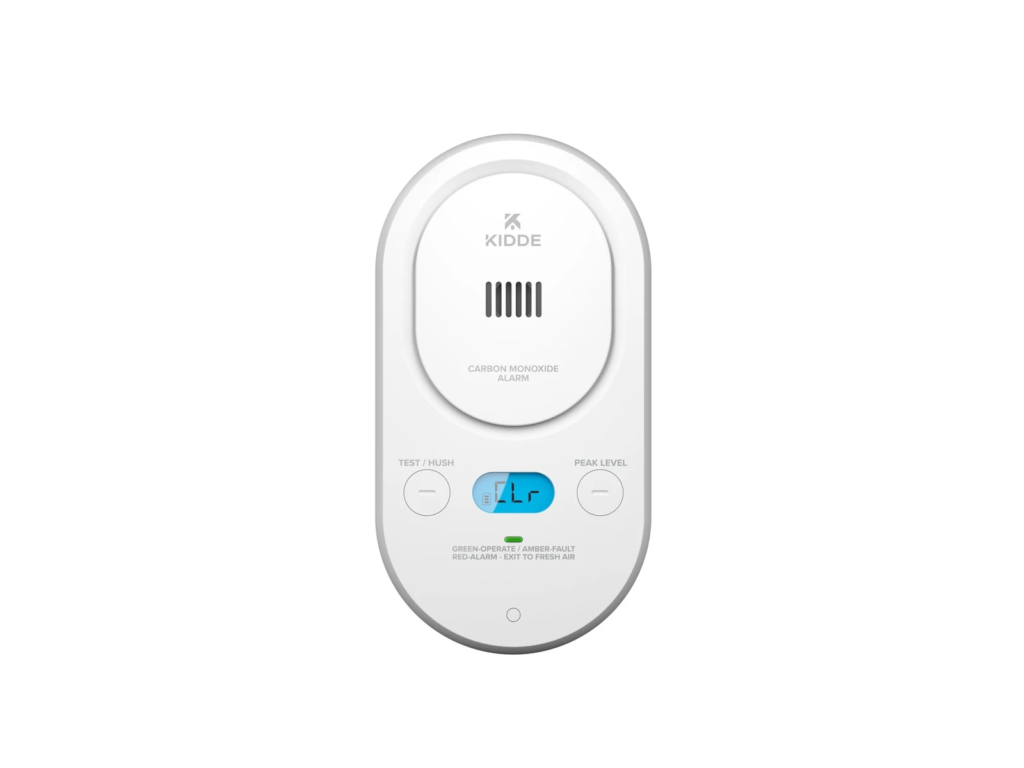
Kidde's render of the COPD, with the display between the Test/Hush and Peak Level buttons. Product image: Kidde
Kidde’s data sheet lists the UL 2034 alarm windows of 60-240 minutes at 70 ppm, 10-50 minutes at 150 ppm and 4-15 minutes at 400 ppm. These are the published permitted windows. They are not our measurements of this unit’s response.
The guide says these models have not been investigated for alarm below 70 ppm. During a CO alarm, the display alternates between the CO level and CO. Peak Level Memory is available after the unit detects 100 ppm or more, or a model-specific low-level alert. The COPD does not have that separate low-level alert.
If you have symptoms or a medical concern about exposure at lower concentrations, ask a healthcare professional. Kidde points readers with concerns about 30-70 ppm exposure to their doctor. The guide identifies COPDL10 and COPDLG as models with a low-level alert, but choosing one is not a substitute for medical advice.
If the alarm sounds, move to fresh air and call emergency services as directed in the manual. Do not wait for a display number to decide whether to respond. See the related CO alarm safety guidance when checking a replacement.
Which outlets it can use
Not rated · Evidence: maker figures only
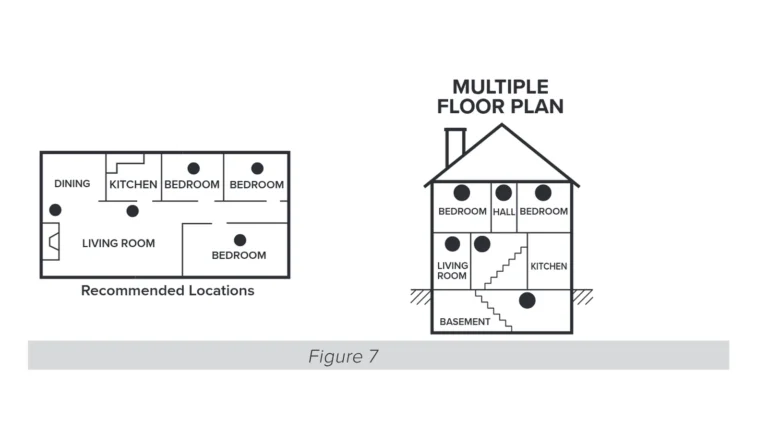
Figure 7 from Kidde's guide: recommended alarm spots in a single-floor plan and a house with a basement. Figure: Kidde CO plug-in alarm user guide
The COPD has no cord and plugs straight into a standard 120 V outlet that isn't on a switch or a dimmer. Its plug turns 90 degrees for an outlet mounted sideways. Only the gas-sensing COPDLG in the same guide comes with a cord for wall mounting, so the outlet you have is the spot you get.
Kidde's guide asks for an alarm on every level of the home, ideally on any level with a fuel-burning appliance and outside sleeping areas. The CPSC gives the same advice and adds that interconnected alarms are best, because they all sound together. The COPD can't be linked to other alarms, according to its data sheet. Its list of places to avoid rules out several outlets you might reach for first:
The garage, or anywhere colder than 40°F or hotter than 100°F.
Within 6 ft of a furnace, water heater or stove.
Within 3 ft of a bathroom door with a tub or shower, a forced-air duct or a ceiling fan.
Next to vents, flues, windows and doors to the outside.
Check the hallway outlet between the bedrooms against that list first. Furniture or drapes must not block the vents on the alarm.
Two AA batteries, quiet nights and a 10-year end
Not rated · Evidence: maker figures only
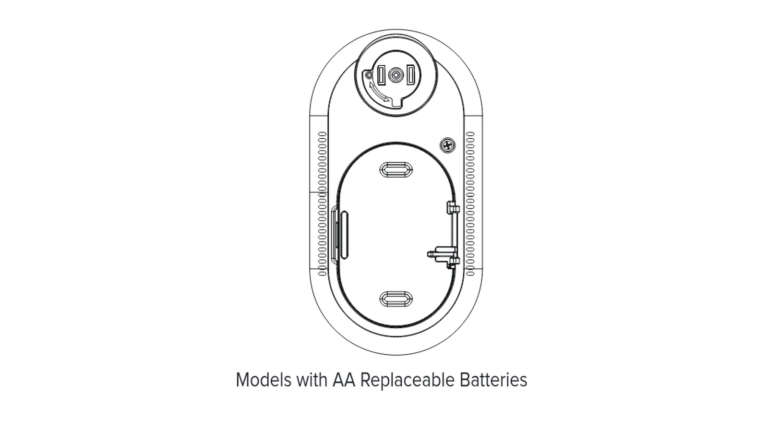
The guide's back view of the AA-battery plug-in models, with the rotating plug above the battery door. Figure: Kidde CO plug-in alarm user guide
The two AA batteries only carry the alarm through power cuts. Kidde names Energizer E91, Gold Peak 15A or Golden Power GLR6A as replacements and rules out lithium cells. Pull the battery tab before you plug the alarm in, or it starts a false low-battery chirp.
Kidde's chirp codes for this model are a single chirp every 60 seconds for low batteries and two chirps every 60 seconds at end of life. The COPD holds back the low-battery chirp in the dark, so a weak battery won't wake anyone at night, while a real alarm still sounds. That's worth having, and it's the one thing the COPD adds over the plain COP besides the display.
Ten years after you first power it, the alarm signals that it needs to be replaced. Write the replace-by date on the label on its side before you plug it in. Kidde's limited warranty also runs 10 years and excludes the batteries.
Where to buy
In-stock offers for this exact model, sorted by item price in USD. Shipping is not included unless a retailer supplies it. Not every retailer is listed. Prices last checked 2 days ago.
Retailer prices for the Kidde COPD carbon monoxide alarm, plug-in, 2 AA backup batteries, digital display (ordering number 21033779)
Prices and availability come from retailer feeds and change without notice; the retailer’s page is authoritative. We may earn a commission if you buy through these links.
✓
Final verdict
Kidde COPD carbon monoxide alarm, plug-in, 2 AA backup batteries, digital display (ordering number 21033779)
RecommendationRecommended for a suitable outlet outside sleeping areas, with the placement limits checked
This review gives no score out of 10, because no section rests on a measurement by an independent body. The recommendation and the written verdict stand on their own.
Pros
Two AA batteries keep it working through power cuts
After CO of 100 ppm or more, the Peak Level button shows the highest reading it recorded
No low-battery chirps at night
Ten-year life and a 10-year limited warranty
Cons
No early alert for CO below 70 ppm, which Kidde's COPDL10 adds
Has to sit in the outlet, with no cord for wall mounting
Can't be interconnected with other alarms
Not for garages or rooms below 40°F
Lithium AA batteries aren't allowed
Conclusion
Our research-based editorial rating is 7.0/10. A display and peak memory are useful, while this model lacks a low-level alert. Outlet placement and standalone operation limit installation choices. Replaceable AA backup batteries and a ten-year replacement signal simplify upkeep. The score assesses the documented features and limitations. It does not represent hands-on performance testing.
Our take
Check the hallway outlet against the placement list before buying. This model’s rotating plug helps with socket orientation, but the alarm still has to occupy a suitable outlet.
Best for
Hallways outside bedrooms with a free outlet
Renters who want an alarm they can take with them
Consider an alternative if
You specifically need a low-level CO alert
Your only available outlet is in a prohibited location
Kidde's guide says the COPD has no low-level CO alert. Its display shows the level during an alarm, and the Peak Level button shows the highest reading after CO of 100 ppm or more. Kidde's COPDL10 adds an alert for lower levels.
Can I use lithium batteries in the Kidde COPD?
No. Kidde's data sheet lists Energizer E91, Gold Peak 15A or Golden Power GLR6A alkaline AA batteries and says not to use lithium.
When does the Kidde COPD need to be replaced?
The COPD signals end of life 10 years after it's first powered, with two chirps and two amber blinks every 60 seconds. Kidde suggests writing the replace-by date on the label on its side when you install it.
Ciprian founded Abode & Grove and takes editorial responsibility for it. He sets the rules its AI tools work to, starting with which sources count: makers’ manuals, safety regulators and university extension services. He sets how a review is scored, and no commercial relationship changes a verdict. He decides which drafts are published and handles corrections. Based in Bucharest.
This is a research-based assessment: the reviewer compiled it from published specifications, documentation and independent measurements rather than from testing the unit.
RecommendedKidde COPD carbon monoxide alarm, plug-in, 2 AA backup batteries, digital display (ordering number 21033779)Compare prices
Cookies on Abode & Grove
We keep cookies to a minimum. Without your consent, this site sets only the ones it needs to work: remembering your answer here and keeping the site secure. If you allow analytics cookies, Google Analytics counts visits and shows us which pages people read. If you allow functional cookies, embedded videos you choose to always show are remembered. We run no advertising cookies. Cookie policy
Customise consent preferences
Each category below lists the exact cookies behind it, what they do and how long they last. Strictly necessary cookies cannot be switched off because the site would stop working without them. Anything else is yours to decline.
NecessaryAlways active
Strictly necessary cookies keep the site working and secure: they remember your choice here, help the security layer stop attacks and keep site accounts signed in to the admin area. The site cannot run without them.
Show the cookies in this category (7)
cmp_consent
Abode & Grove · 1 year
Remembers your consent choice for each cookie category, so the banner does not ask again on every page.
wp-settings-(id), wp-settings-time-(id)
WordPress · 1 year
Remembers layout preferences inside the WordPress admin screens. Set only for accounts that sign in to run the site, never for ordinary visitors.
WordPress · Session, or 14 days if “Remember me” is ticked
Keeps a site account signed in to the WordPress admin, and checks that the browser accepts cookies at login. Set only for accounts that sign in to run the site, never for ordinary visitors.
wfwaf-authcookie-(hash)
Wordfence (Defiant, Inc.) · 12 hours
Lets the Wordfence firewall check a signed-in user’s access level before WordPress loads, so administrators are not blocked by firewall rules. Set only when you log in to the site.
wf_loginalerted_(hash)
Wordfence (Defiant, Inc.) · Persistent
Records that the administrator has already been alerted about a sign-in from this device. Only used if login alerts are enabled, and set only when you log in to the site.
wfCBLBypass
Wordfence (Defiant, Inc.) · Only if enabled
Allows a visitor who knows a hidden bypass address to pass country blocking. It is only used if country blocking is enabled, and we do not currently use it.
wfls-remembered-(hash)
Wordfence (Defiant, Inc.) · Up to 30 days
Remembers a trusted browser for two-factor login when a signed-in user chooses “remember this device”. Set only for site accounts that use two-factor authentication.
Functional
A functional cookie is set only when you tick “Always display content from …” on an embedded video or post. Decline and the rest of the site works exactly as before, and embedded videos still load one at a time when you click them.
Show the cookies in this category (1)
embed-privacy
Abode & Grove · 1 year
Remembers the providers whose embedded content you chose to always display (for example YouTube), so their videos and posts load without a click. Set only when you tick “Always display content from …”, a box that appears only once functional cookies are allowed.
Analytics
Analytics cookies let Google Analytics count visits and show us which pages people read and how they found them, so we know what to improve. Google Analytics loads only after you switch this on. Google signals and ad personalization are turned off, and Google Analytics does not log or store IP addresses. Decline and the site works exactly the same.
Show the cookies in this category (2)
_ga
Google (Google Analytics) · 13 months
Gives your browser a random ID so Google Analytics can tell new visitors from returning ones. It holds no name, email address or account. Set only after you allow analytics cookies.
_ga_MW4G9ZP17G
Google (Google Analytics) · 13 months
Keeps track of the current visit for this site’s Google Analytics property, such as when it started and how many pages it covered. Set only after you allow analytics cookies.
Set by other sites
These are set by another company, not by this site: a retailer, after you click through to its website, or a video or social-media provider, after you click to load its content here. That company’s own policy governs them, not this banner.
Show the cookies in this category (2)
Embedded video and social-media cookies
YouTube, Vimeo, TikTok, Instagram, Spotify, X, Reddit · Set by the provider
Articles can embed a video or post. Nothing loads from the provider until you click its placeholder; when you do, the provider may set or read its own cookies under its own policy. YouTube videos load in YouTube’s privacy-enhanced mode (youtube-nocookie.com).
Retailer / affiliate cookies
Amazon & affiliate networks · Set by the retailer
Set on the retailer’s own website after you click a “View deal” or “Check price” link, to attribute a purchase. We do not set or read these.